

I still remember sitting across from my cousin at a wedding a few years back, and he leaned in and asked me, half-joking, half-serious: “Bro, you’re a software guy… how much do you people actually earn?” I laughed, because honestly, that question comes up more than you’d think. Family dinners, LinkedIn DMs, random coffee chats with juniors trying to break into tech — everyone wants to know the same thing. And the funny part? There’s no single clean answer. It depends on where you live, what stack you know, how many years you’ve grinded, and sometimes just plain luck with timing.
Let’s actually talk about it properly. Not in some robotic “here are five bullet points” way, but the way I’d explain it if we were grabbing chai and you asked me directly.
Why This Question Feels So Complicated
Pay for developers isn’t like a government pay scale where everyone at a certain grade earns the same. It’s messy. A junior dev in a small city working for a local agency might make a fraction of what a mid-level engineer earns remotely for a US startup. And that’s not even unfair — it’s just how the market works. Skills, location, company size, and negotiation ability all pull the number in different directions.
I’ve seen two developers graduate from the same batch, same college, same GPA even, and three years later one is earning triple the other. Not because one is smarter. Just because one learned to negotiate, picked a growing niche (cloud, AI tooling, whatever), and wasn’t afraid to switch jobs when the offer made sense.
The Real Range You Should Expect
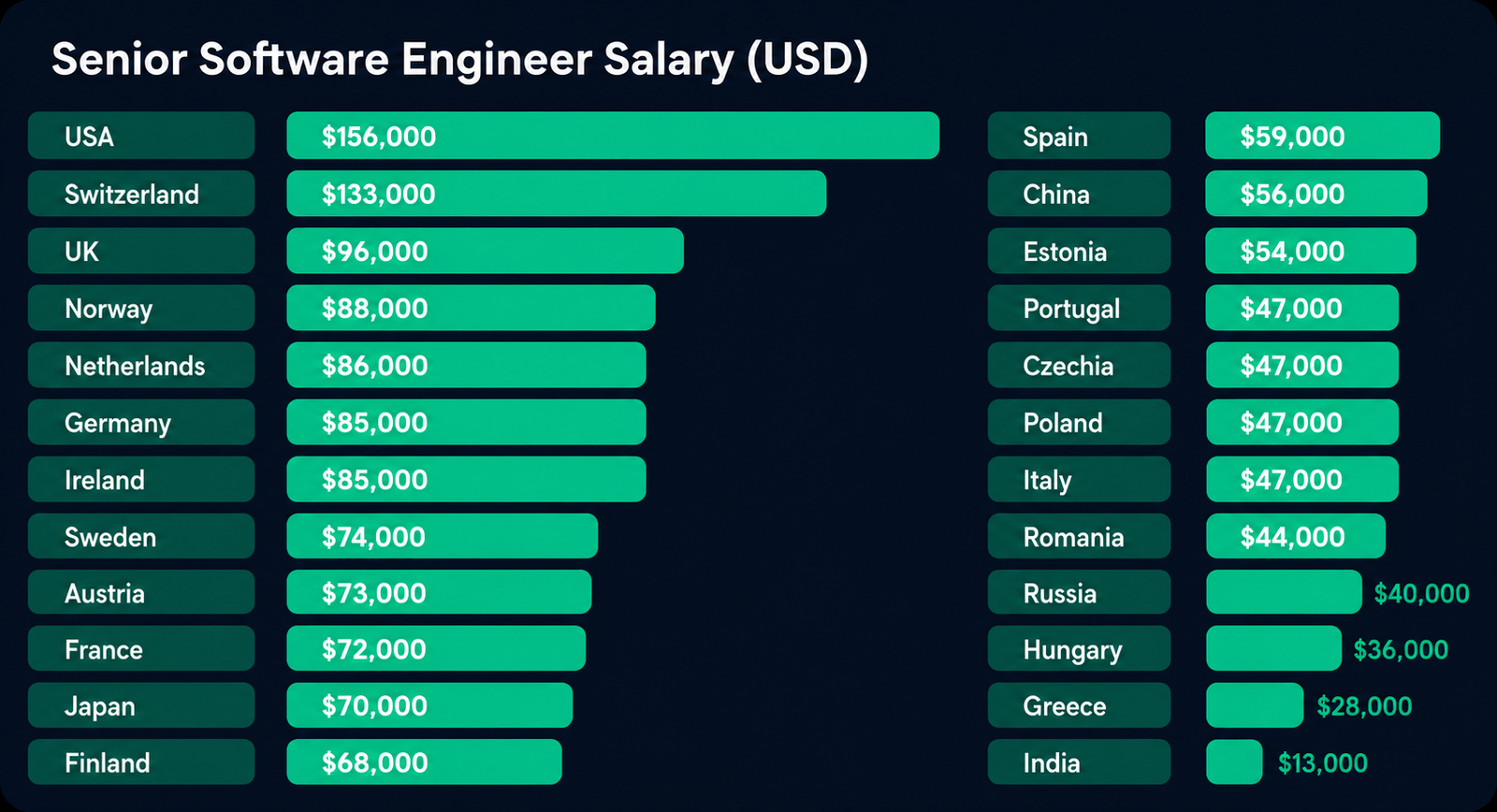
Okay, numbers. In the US, entry-level developers typically land somewhere between $70,000 and $95,000 a year, depending on the city and company. Mid-level folks with three to six years of solid experience often sit in the $100,000 to $140,000 range. And senior engineers — the ones who’ve shipped real production systems, mentored teams, maybe led a migration or two — can easily cross $160,000, sometimes touching $200,000+ at bigger tech companies.
Now here’s the thing nobody tells beginners clearly enough — location changes everything. A software engineer salary in San Francisco or Seattle looks completely different from the same role in a smaller Midwest city. Cost of living plays a part, sure, but so does the concentration of tech companies competing for talent. More competition for hiring usually pushes pay up.
Outside the US, it shifts again. In India, for example, a fresher might start around ₹4-8 LPA at a decent company, while someone with five-plus years at a product-based firm could be pulling in ₹25-40 LPA or more. Europe sits somewhere in between depending on the country — Germany and the Netherlands tend to pay better than, say, Eastern Europe, though the cost of living gap narrows things out a bit.
Why Averages Can Be Misleading
Here’s something I wish someone told me earlier — average numbers you see on salary websites are often skewed by big tech giants. Google, Meta, Amazon, these companies pay well above market rate, and when they’re included in the dataset, the “average” looks inflated. So if you’re comparing your offer to some article that says the average is $130,000, and you’re getting $85,000 at a mid-size company, don’t panic. That average probably includes a chunk of FAANG salaries pulling the number up.
What Actually Moves the Needle
I’ve had this conversation with a lot of junior devs who ask, “What should I learn to earn more?” And honestly, it’s rarely just about learning more frameworks. It’s about a mix of things.
Experience matters, obviously. But not just years on paper — what you actually built. Two people with five years of experience can have wildly different skill depth. One might’ve built the same CRUD app five times, the other might’ve architected systems handling millions of requests.
Specialization pays. Generalist developers are useful, sure, but engineers who go deep into things like cloud infrastructure, machine learning engineering, or security tend to command a premium. It’s supply and demand — fewer people can do it well, so companies pay more to get them.
Company type changes everything. Startups sometimes pay less in base salary but throw equity at you (which may or may not ever be worth anything, let’s be honest). Big established tech companies usually pay the most in cash and stock combined. Government or public sector jobs? Stable, decent benefits, but rarely competitive salaries.
Negotiation is underrated. I know a guy — sharp coder, decent portfolio — who took the first offer he got without pushing back. Six months later he found out a teammate with less experience was earning 20% more, simply because that person negotiated. It stung him, understandably. Don’t be that guy. Companies almost always have room to move on the initial number, especially for mid to senior roles.
Explore More Helpful Guides on: Sharemyideaz
Remote Work Changed the Game
This part genuinely excites me because I’ve watched it unfold in real time. A few years ago, if you lived outside a major tech hub, your earning potential was basically capped by your local market. Now? Remote-first companies are hiring globally, and someone sitting in a smaller city can land a software engineer salary that would’ve been unthinkable for that location a decade ago.
Of course, it’s not all sunshine. Remote roles are more competitive — you’re not just competing with people in your city anymore, you’re up against candidates worldwide. And some companies adjust pay based on your location (a practice that annoys a lot of remote workers, understandably). Still, on balance, remote work has been one of the biggest positive shifts for developer compensation, especially for folks in countries where local tech salaries lag behind US or European standards.
Freelancing and Contract Work
I’ll be honest, I didn’t take freelancing seriously for a long time. Thought it was inconsistent, unstable, not “real” work compared to a full-time job. But a friend of mine switched to contract-based development work — mostly building and maintaining backend systems for a handful of clients — and now earns more per month than he did in his last full-time gig, with more flexibility too. It’s not for everyone. You need discipline, you need to hustle for clients initially, and income can be lumpy. But it’s a legitimate path, and worth mentioning whenever someone asks about earning potential in this field.
Which Tech Stacks Tend to Pay Better
I get asked this a lot, so let me just lay it out plainly, without pretending there’s a magic answer.
Cloud and DevOps skills (AWS, Azure, Kubernetes) tend to pay well because most companies are migrating infrastructure and there aren’t enough experienced people to do it properly. Machine learning and AI-related roles have seen a genuine spike in pay over the last couple of years — not surprising given how much money is flowing into that space right now. Backend engineers working with distributed systems, especially at scale, also tend to earn more than pure frontend developers, though that gap has narrowed as frontend complexity has grown too (React, state management, performance optimization — it’s not “easy” anymore, whatever some people still think).
That said, I want to be careful here — chasing the “highest paying stack” purely for money, without any genuine interest, usually backfires. You end up mediocre at something you don’t enjoy, and mediocre developers rarely command top pay regardless of the technology. Pick something you can actually get good at.
A Quick Story About Job Hopping
A former colleague of mine — smart guy, a bit impatient — switched jobs three times in four years. Each time, his base pay jumped noticeably, sometimes 25-30%. Now, I’m not saying job hopping is always the answer, and there are real downsides (companies can be wary of frequent switchers, and you lose out on deeper growth within one team). But it’s undeniable that switching companies is often the fastest way to boost your software engineer salary, faster than waiting for annual raises that typically hover around 3-6%.
There’s a trade-off, though. Loyalty sometimes gets rewarded with promotions, deeper trust, bigger projects. Hopping too much can make you look unstable on paper. Like most things in a career, it’s a balance, and only you can judge how much risk feels right at your stage of life.
Benefits Beyond the Paycheck
Something people forget to factor in — total compensation isn’t just the number on your offer letter. Health insurance, retirement contributions, stock options, remote flexibility, learning budgets, even something as simple as fewer working hours — these add real value that doesn’t always show up when comparing raw salary figures.
I’ve turned down a higher-paying offer once because the other company offered better work-life balance and genuine flexibility around my hours. In hindsight, absolutely the right call for me personally. Somebody else in the exact same situation might’ve made the opposite choice, and that would’ve been right for them too. There’s no universal correct answer here, just what matters most to you at that point in your life.
How to Actually Increase Your Own Number
If you’re reading this hoping for practical steps rather than just industry commentary, here’s what’s genuinely worked for people I know personally.
Build things outside of work. Side projects, open-source contributions, even a well-documented GitHub portfolio — these give you leverage in interviews that a resume alone can’t. Learn to talk about your work in terms of impact, not just tasks. Saying “I optimized a database query” is fine, but saying “I reduced page load time by 40%, which improved user retention” tells a much stronger story, and interviewers notice the difference.
Get comfortable negotiating, even if it feels awkward at first. Most people underestimate how much room companies actually have. And don’t be afraid to walk away from an offer that undervalues you, assuming your situation allows for that flexibility.
Finally, keep learning, but with intention. Don’t just chase every shiny new framework because it trends on Twitter for a week. Build genuine depth in one or two areas, and let breadth come naturally over time.
Final Thoughts
There’s no perfect number I can hand you and say “this is what you’ll earn.” A software engineer salary depends on too many moving pieces — location, experience, specialization, company, even the timing of when you’re job hunting. What I can say, from watching this industry closely for years, is that consistent effort, genuine skill-building, and a willingness to advocate for yourself tend to pay off, sometimes slower than you’d like, but they do add up.
If you’re just starting out, don’t get discouraged by numbers that seem unreachable right now. Everyone starts somewhere, and the gap closes faster than you’d expect once you’re actually in the field, learning by doing.
Browse More Articles on: Sharemyideaz
FAQs
Q: Is software engineering still worth it in terms of pay?
A: Yeah, generally speaking, it still holds up well compared to most other career paths, especially considering how many remote and global opportunities have opened up in recent years. It’s not the gold rush it was a few years back, but it’s far from a bad choice.
Q: Does a degree affect how much you can earn?
A: It can help, especially for landing that first job at bigger companies that filter by education. But once you have two or three years of real experience, what you’ve actually built starts to matter far more than where you studied.
Q: Why do some companies pay so much more than others for the same role?
A: Usually it comes down to how much revenue the company generates, how competitive their hiring market is, and how much they value engineering as a core part of the business versus treating it as a cost center.
Q: Should I move to a bigger tech hub for a higher salary?
A: Depends on your priorities honestly. If pure earning potential matters most and remote isn’t an option in your situation, yes, hubs generally pay more. But factor in cost of living and lifestyle preferences before deciding, because a bigger number doesn’t always mean more savings at the end of the month.
Q: How often should I expect a raise?
A: Annual raises are common but tend to be modest, often just keeping up with inflation. Bigger jumps usually come from promotions or switching companies, so don’t rely solely on yearly reviews if growing your income quickly matters to you.
