

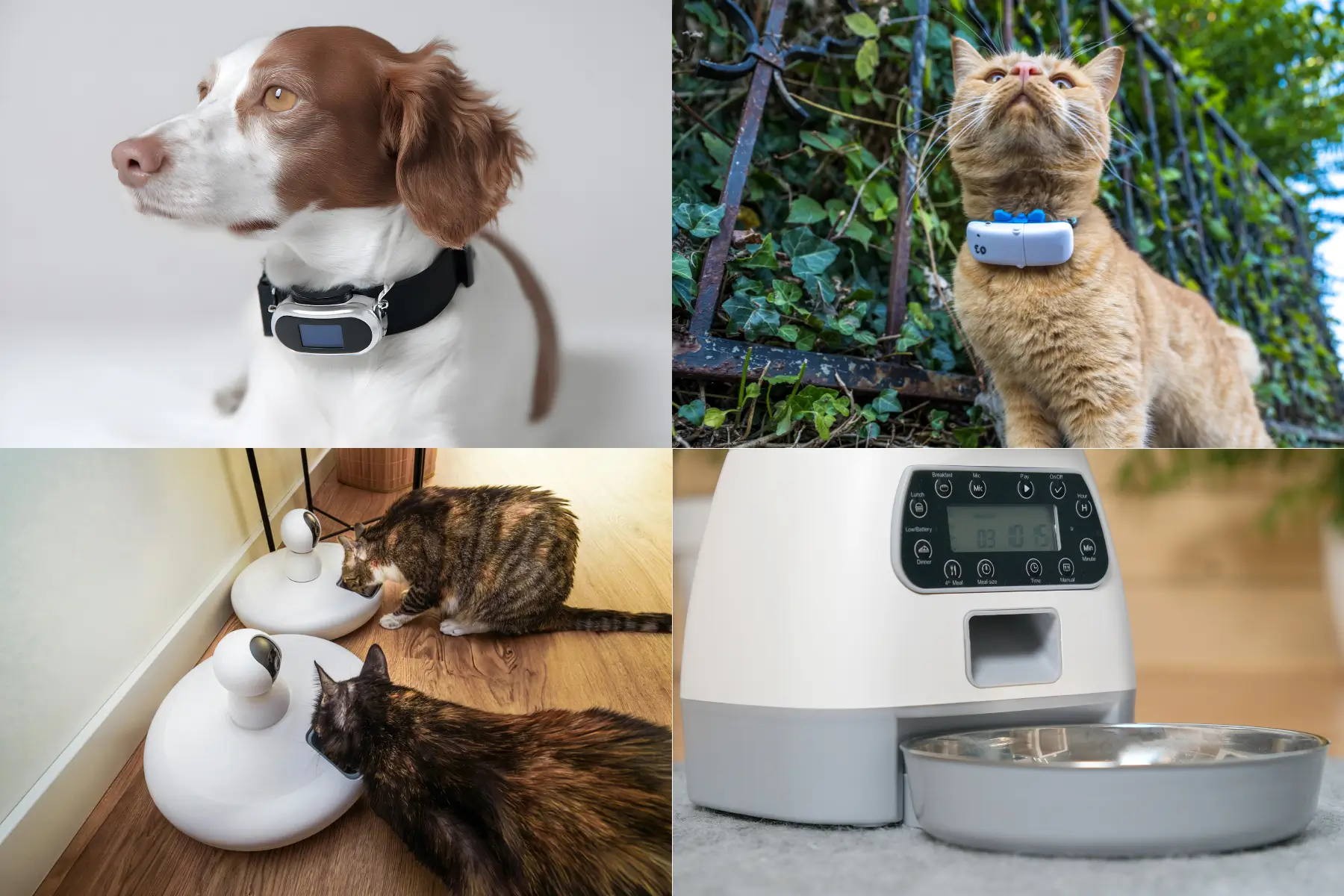
My neighbor’s cat has a collar that tracks her sleep. I found this out last month when she showed me an app on her phone with little graphs of “REM cycles” for an animal that spends 16 hours a day napping on a windowsill anyway. It made me laugh, but it also got me thinking about how far this whole category has come — and how much of it is genuinely useful versus, well, a graph nobody needed.
That’s really the question most people are asking when they search for pet tech gadgets. Not “what exists” — a two-minute scroll through Amazon answers that. The real question is: does any of this stuff actually help, or is it just expensive plastic with a Bluetooth chip inside?
Quick Answer
Pet tech gadgets are internet-connected or app-linked devices — trackers, feeders, cameras, health monitors — built to help owners monitor, feed, entertain, or communicate with pets remotely. The good ones solve a real problem (missed feedings, lost pets, unclear health signs). The bad ones solve a problem you didn’t have and charge you monthly for the privilege. Whether they’re “worth it” comes down to your specific pet, your daily routine, and how much you trust a subscription app to matter more than common sense.
What Are Pet Tech Gadgets, Really
Strip away the marketing and pet tech gadgets fall into a handful of honest categories: GPS trackers that clip onto a collar, automatic feeders that dispense food on a schedule, smart cameras that let you peek in on your dog from the office, wearable health monitors that watch activity and sometimes vital signs, and interactive toys meant to keep a bored animal occupied while you’re not home.
None of this is new in concept. Timed feeders existed decades before Wi-Fi. What changed is connectivity — now a feeder can text you when it’s low on kibble, a collar can ping your phone the moment your dog crosses a fence line, and a camera can let you toss a treat across the living room from a hotel room in another state. The tech didn’t invent pet care. It just wired existing tools into your phone.
How It Actually Works
Most devices in this space rely on one of three technologies, and knowing which one matters more than people expect.
GPS and cellular trackers work almost exactly like a phone does — they ping satellites and cell towers to report location, which is why most require a monthly data plan on top of the hardware cost. This is the part people are often surprised by after buying one.
Bluetooth trackers are cheaper and don’t need a subscription, but they only work within a limited range — usually 100 to 400 feet — so they’re better for finding a pet that slipped under the porch than one that got loose three blocks away.
Wi-Fi connected devices — feeders, cameras, water fountains — talk to your home network and then to an app, usually cloud-hosted. This is convenient until your internet goes down, at which point that “smart” feeder becomes a very average manual one until it reconnects.
Health-monitoring wearables are the newest and least standardized part of the category. Some use accelerometers to estimate activity level (steps, scratching, rest time). A smaller number use actual sensors for heart rate or temperature, and those tend to cost significantly more and come from companies with veterinary partnerships rather than general electronics brands.
Main Features Worth Knowing About
Not every gadget does all of this, but here’s what shows up across the category:
- Geofencing – alerts you the moment your pet leaves a set zone
- Activity and sleep tracking – daily movement summaries, sometimes compared against breed averages
- Scheduled or portion-controlled feeding – useful for pets on vet-recommended diets
- Two-way audio and video – talk to your pet, and in some cases hear them bark or whine back
- Health anomaly alerts – some devices flag unusual scratching (possible allergies) or lower activity (possible pain or illness)
- Multi-pet support – shared apps that track more than one animal, handy for multi-pet households
The geofencing and feeding features tend to be the most reliably useful in practice. The health-alert features are where I’d slow down — more on that in a minute.
Pros and Cons
Pros
- Real peace of mind for owners of escape-prone dogs or outdoor cats
- Useful for pets with medical feeding schedules (diabetic cats, for example, need precise timing)
- Genuinely helpful for people who travel or work long hours and want visual check-ins
- Can catch early behavior changes that owners might otherwise miss
- Good for multi-pet or multi-person households needing shared visibility
Cons
- Subscription costs stack up fast — a $50 tracker can turn into $150–200 a year once you add cellular service
- Battery life on GPS trackers is often shorter than advertised, especially in cold weather
- Health data from consumer wearables isn’t diagnostic — it flags patterns, it doesn’t replace a vet
- Wi-Fi dependent devices fail exactly when you need them most (power outage, travel, spotty connection)
- Some pets chew, scratch off, or simply refuse to tolerate wearables, which nobody mentions in the five-star reviews
Real-World Examples
A friend of mine has a beagle with a nose for trouble and a talent for finding gaps in fences. She uses a cellular GPS collar, and it’s paid for itself twice over just in the anxiety it’s saved her — she gets an alert within a minute of him leaving the yard instead of finding out an hour later that he’s gone.
On the other end, I’ve talked to a cat owner who bought an automatic feeder mainly to stop 5 a.m. wake-up calls from a food-obsessed tabby. It worked for about three weeks, until the cat learned to headbutt the dispenser lid open manually. So — mixed results, and that’s worth being honest about.
Interactive treat-dispensing cameras get a lot of buzz, and they’re genuinely fun for a dog that handles novelty well. But I’ve also seen anxious dogs get more stressed by a randomly talking box on the floor than they were by simply being left alone with a chew toy. The gadget isn’t universally better — it depends heavily on the individual animal’s temperament.
Safety, Privacy, and Legitimacy
This is the part people don’t ask about enough, and probably should.
Camera-based pet gadgets are internet-connected devices sitting inside your home, which means the same privacy considerations apply as with any smart camera — how the company stores footage, whether it’s encrypted, and what happens to that data if the company is acquired or shuts down. Reading the privacy policy before buying isn’t paranoid; it’s just sensible given a few well-documented cases of smart home footage being accessed without proper authorization.
On legitimacy: most major pet tech brands are real companies with functioning products — this isn’t a scam-heavy category the way some supplement or “miracle” pet products are. The bigger risk isn’t fraud, it’s overpromising. A collar that claims to detect early-stage illness with high accuracy should be read skeptically unless there’s actual veterinary research behind the claim, not just marketing copy.
Common Problems and Limitations
- GPS drift — signals can be inaccurate by dozens of feet, especially in dense urban areas or under heavy tree cover
- App reliability — a surprising number of one-star reviews across this category are about buggy apps, not bad hardware
- False health alerts — activity trackers sometimes flag a lazy Sunday as a health concern, which can cause unnecessary worry
- Collar fit issues — especially for small dogs and cats, where added weight and bulk matter more
- Ongoing cost — this deserves repeating, because it’s the single most common regret people mention after buying
Pet Tech Gadgets vs. Traditional Methods
A basic ID tag with a phone number is still, hands down, the most reliable “if lost” tool that exists — it doesn’t need charging and it works even if the battery on your fancy tracker dies. Microchipping is a strong complement to GPS tracking, not a replacement, since a chip only helps once someone finds your pet and takes them to a vet or shelter to be scanned.
For feeding, a simple timer-based feeder without an app does the core job — dispensing food on schedule — for a fraction of the price of a connected one. The app-based version adds convenience (remote adjustments, portion tracking) but not necessarily better outcomes for the pet.
Where pet tech gadgets genuinely pull ahead of traditional methods is real-time visibility. No amount of old-school pet care gives you a live video feed or an instant “your dog just left the yard” alert. That immediacy is the actual value proposition — not that it makes you a better pet owner, but that it closes an information gap traditional tools can’t.
An Honest, Practical Opinion
If I’m being straight with you: most pet tech gadgets are solving inconvenience, not neglect. They don’t replace attentive care, and I’d be wary of any product description that implies they do. The devices that earn their price tag tend to be the boring, single-purpose ones — a reliable GPS tracker, a feeder that does exactly one job well. The ones I’d be more cautious about are multi-function “health monitoring” wearables priced like a smartphone, promising insights that a $150 collar sensor genuinely can’t deliver with medical-grade accuracy.
Buy for the specific problem you have, not for the feature list. An indoor cat that never leaves the apartment doesn’t need GPS. A senior dog with mobility changes might genuinely benefit from an activity tracker that helps you and your vet spot a pattern over weeks, rather than guessing from memory at a checkup.
Final Verdict
Pet tech gadgets are a legitimate, useful category when matched to a real need — not a gimmick, but not magic either. The best ones close a specific gap: knowing where a pet is, making sure feeding happens on time, or getting a heads-up on a behavior change worth mentioning to a vet. The worst ones are subscription traps dressed up as care products. Read the ongoing cost before the feature list, and buy based on your pet’s actual habits, not the glossy lifestyle photos on the box.
Read More Expert Articles on: Sharemyideaz
Frequently Asked Questions
Q: Are pet tech gadgets safe for pets to wear?
A: Generally yes, when sized correctly and not left on 24/7 without breaks. Skin irritation and chewing are the main practical issues, not electrical or chemical safety.
Q: Do GPS pet trackers require a monthly subscription?
A: Most cellular GPS trackers do, since they rely on mobile data plans. Bluetooth-only trackers usually don’t, but they have a much shorter range.
Q: Can a pet health monitor replace regular vet checkups?
A: No. These devices can flag patterns worth mentioning to a vet, but they aren’t diagnostic tools and shouldn’t be treated as a substitute for professional exams.
Q: What’s the biggest downside of pet tech gadgets?
A: The ongoing cost. Subscription fees for GPS and camera features often exceed the price of the device itself within a year or two.
Q: Which pet tech gadget is most worth buying for a first-time buyer?
A: A basic GPS tracker for dogs with outdoor access, or a simple scheduled feeder for pets on a strict diet, tend to offer the clearest, most immediate value.
Q: Do cats actually benefit from pet tech gadgets, or is it mostly a dog-focused category?
A: Cats benefit less from GPS tracking (most stay closer to home) but more from automatic feeders and water fountains, especially for indoor cats on portion-controlled diets.
