

Picture this: two people start businesses on the same day, with roughly the same amount of money, in the same industry. Three years later, one is running a profitable company with a small team. The other closed shop after eighteen months and went back to a 9-to-5. What separated them wasn’t luck, and it usually wasn’t even the idea itself. It was a specific set of abilities — the kind nobody teaches you in a single weekend seminar, no matter what the ads promise.
That’s the honest starting point for talking about entrepreneurship skills. They’re not magic, and they’re not a checklist you tick off once and forget. They’re closer to a muscle group you keep training, sometimes clumsily, while the business is already moving.
Quick Answer (For Anyone in a Hurry)
Entrepreneurship skills are the practical abilities — like problem-solving, financial literacy, communication, decision-making under uncertainty, and resilience — that help a person start, run, and grow a business. They’re learnable through experience, mentorship, courses, and trial and error. They matter because ideas alone rarely succeed; execution does, and execution depends almost entirely on skill.
What Is “Entrepreneurship Skills,” Exactly?
The phrase gets thrown around a lot, often vaguely, so let’s be precise. Entrepreneurship skills refer to the combination of soft and hard abilities a person needs to identify opportunities, build something from them, and keep it alive through the inevitable rough patches.
This isn’t one skill — it’s a cluster. Some of it is analytical (reading a balance sheet, understanding cash flow). Some of it is interpersonal (negotiating with suppliers, managing a team that doesn’t always agree with you). And some of it is almost psychological — the ability to keep functioning when a product launch flops or a client ghosts you mid-contract.
A lot of business schools try to package this into neat frameworks. Real founders will tell you it rarely feels neat. It feels like improvisation backed by a few solid habits.
How Entrepreneurship Skills Actually Work in Practice
Here’s where most explanations get too abstract. In practice, these skills work like this: you hit a problem you’ve never faced before — say, a supplier suddenly doubles their price — and instead of freezing, you draw on a mix of prior knowledge, quick research, and gut instinct to make a decision within a tight window.
The skill isn’t knowing the “right” answer in advance. It’s the process of moving from confusion to a workable decision faster than someone untrained would. Over time, repeated exposure to these situations builds pattern recognition. That’s why a second-time founder often looks calmer under pressure than a first-timer — not because they’re smarter, but because they’ve already lived through a version of the chaos.
Most people build these skills through a mix of:
- Direct experience (starting something small and messing it up safely)
- Mentorship or observing someone who’s already done it
- Structured learning — courses, books, workshops
- Reflection after failure, which is honestly the most underrated method
Main Features of Strong Entrepreneurship Skills
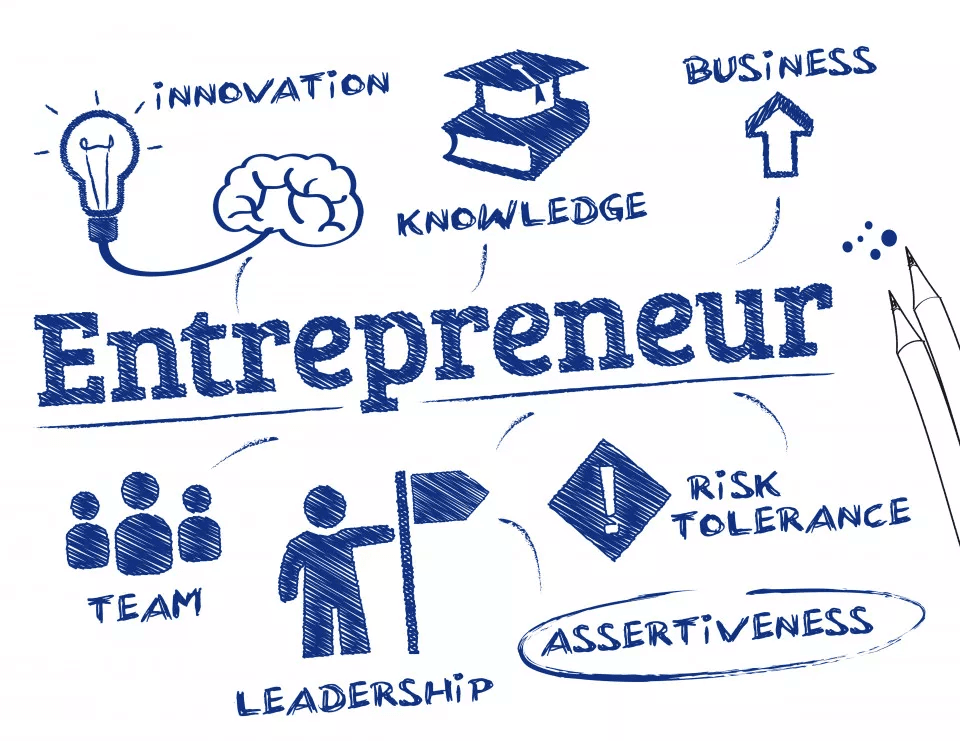
When people talk about someone being “a natural” entrepreneur, they usually mean this person shows a cluster of traits together. Here’s what that cluster typically includes:
Opportunity recognition — noticing gaps in a market before they’re obvious to everyone else.
Financial literacy — understanding cash flow, margins, and runway well enough to avoid running out of money quietly.
Risk management — not avoiding risk entirely, but sizing it correctly instead of betting the whole business on one guess.
Communication and persuasion — pitching to investors, selling to customers, and getting employees to actually believe in the mission.
Adaptability — the willingness to pivot when the original plan clearly isn’t working, without abandoning ship at the first sign of trouble either.
Networking — building relationships that turn into partnerships, clients, or advice down the road.
Resilience — this one gets mentioned so often it sounds like a cliché, but it’s genuinely the difference-maker. Businesses fail constantly in small ways before they succeed in big ones.
None of these exist in isolation. A founder with brilliant financial literacy but zero communication skills will struggle to raise money or build a team, no matter how clean their spreadsheets look.
Pros and Cons of Focusing on Entrepreneurship Skills Development
Pros:
- Skills transfer across industries — someone who learns negotiation in a coffee shop startup can apply it in tech later
- They reduce dependency on luck, which is the one variable nobody can control
- They compound; each failed attempt teaches something the next attempt benefits from
- They’re useful even outside entrepreneurship — employers value them too
Cons:
- Skill-building takes time, and impatient founders often skip this step and pay for it later
- Some “entrepreneurship skill” courses oversell what they can realistically teach — reading about resilience is not the same as living through a cash crunch
- There’s no universal skill formula; what works in one market or culture doesn’t always translate directly
- Overconfidence can develop if someone mistakes theoretical knowledge for tested experience
Real-World Examples and Use Cases
Take a small example that’s easy to relate to: someone opens an online store selling handmade candles. In month two, a shipment arrives damaged, and half the inventory is unsellable. This is where entrepreneurship skills show up in real time — not as a textbook concept, but as a decision: do you refund customers immediately and eat the loss to protect your reputation, or delay and risk bad reviews?
There’s no universally correct answer, but a founder with decent risk management and communication skills usually handles this better than one without. They’ll likely communicate proactively with customers, absorb the short-term hit, and protect long-term trust.
Another common scenario: a freelance consultant scaling into an agency. The technical skill (say, marketing expertise) got them clients in the first place. But hiring, delegating, and managing people is an entirely different skill set — and this is usually the point where technically skilled people either grow into effective leaders or burn out trying to do everything themselves.
Is It Safe, Legitimate, and Actually Worth Developing?
This part matters because there’s a lot of noise online — “entrepreneurship skills” courses, certifications, and coaching programs that promise transformation in a few weeks. Some of it’s genuinely useful. A lot of it is repackaged common sense sold at a markup.
Here’s a fair way to think about legitimacy: entrepreneurship skills themselves are absolutely real and valuable — this isn’t a trend or a gimmick. What deserves scrutiny is any program claiming it can install these skills instantly, or guarantee business success. No course can substitute for the actual experience of making a decision with real money on the line.
If you’re evaluating a course or coach, look for a few signals: do they show real case studies with specific, verifiable outcomes? Do they acknowledge failure as part of the process, or only showcase highlight reels? Programs that only talk about wins tend to be selling motivation, not skill.
Common Problems and Limitations
A few honest limitations worth mentioning:
- Skills alone don’t guarantee success — market timing, capital access, and sheer chance still play a role
- Some people develop skills in theory but freeze when actual money or reputation is at stake
- Overreliance on frameworks can slow decision-making; sometimes the “textbook” approach doesn’t fit the situation
- Skill development is uneven — someone might be great at sales and genuinely weak at operations, and ignoring that gap causes real damage later
How It Compares to Formal Business Education
Formal degrees like an MBA teach structured frameworks — finance, strategy, operations — in a controlled environment. Entrepreneurship skills, by contrast, are usually built through direct exposure to uncertainty, which a classroom can only simulate so well.
Neither approach is strictly superior. An MBA can shortcut some of the theoretical learning curve, but it rarely replicates the emotional weight of watching your own money disappear from a business account. Many successful founders have no formal business education at all; others credit their MBA with giving them a vocabulary and network they wouldn’t have built otherwise. The honest answer is that both paths can work, and combining structured learning with real practice tends to beat either one alone.
A Practical, Experience-Based Opinion
If there’s one thing worth saying plainly: people overestimate how much they can learn before starting and underestimate how much they’ll learn in the first six months of actually doing it. Reading about cash flow management is useful. Watching your own account balance drop while invoices sit unpaid teaches it faster and more permanently.
That said, going in with zero preparation isn’t smart either. A reasonable middle ground is learning just enough of the fundamentals — basic budgeting, a simple grasp of your target customer, a rough sense of your break-even point — and then letting real experience refine the rest. Waiting until you feel “ready” often means waiting forever, because the confidence mostly shows up after you’ve already survived a few hard weeks, not before.
Final Verdict
Entrepreneurship skills are real, learnable, and genuinely predictive of business survival — far more than raw intelligence or a “great idea” ever is. They’re not something you acquire once and keep forever, either; they need maintenance, especially as a business grows and the problems it faces change shape. Anyone expecting a shortcut through a course or certificate alone is likely to be disappointed. Anyone willing to combine some structured learning with actual, messy, occasionally embarrassing experience will build these skills faster than they expect.
Explore More Insights: Sharemyideaz
FAQs
Q: Can entrepreneurship skills be learned, or are some people just born with them?
A: They can absolutely be learned. Some personality traits (like comfort with risk) may come more naturally to certain people, but skills like financial literacy, negotiation, and decision-making are built through practice and exposure, not innate talent.
Q: What’s the fastest way to build entrepreneurship skills?
A: There’s no true shortcut, but combining small real-world practice — like running a side project — with mentorship from someone experienced tends to accelerate learning far more than courses alone.
Q: Do I need a business degree to develop these skills?
A: No. A degree can help with structured knowledge, but many successful entrepreneurs built their skills entirely through hands-on experience and self-directed learning.
Q: Are entrepreneurship skills useful outside of starting a business?
A: Yes. Skills like problem-solving, communication, and financial literacy transfer well into corporate roles, freelance work, and even personal financial management.
Q: How do I know if an entrepreneurship course is legitimate?
A: Look for verifiable case studies, transparent discussion of failures (not just wins), and realistic claims. Be cautious of anything promising guaranteed success or overnight transformation.
Q: What’s the biggest mistake people make when trying to develop these skills?
A: Over-preparing without ever testing the skills in a real situation. Reading and planning matter, but the actual learning accelerates once real stakes are involved.
