

If you searched for this hoping to find a seat map, amenity kit photos, or a “should I book it” verdict, I need to stop you before you scroll further and get disappointed halfway through. There’s a twist here that most articles on this topic gloss over, and it changes everything about how you should think about booking a flight.
I’ve spent a fair bit of time digging through Cathay Pacific’s fleet plans, cabin retrofits, and route announcements to sort out what’s real, what’s rumor, and what’s still years away. Here’s the short version: the plane itself hasn’t started flying with passengers yet.
Quick Answer
Cathay Pacific’s A330neo (Airbus A330-900) is a next-generation regional widebody that the airline has ordered but not yet taken delivery of. Cathay <cite index=”10-1″>has confirmed 30 factory-fresh A330neo jets arriving from 2028 through to 2031</cite>, and it’s still being decided exactly what business class seat will go on them. So if you’re searching for “cathay a330neo business class” hoping to book it next month, that flight doesn’t exist yet. What you can book right now is Cathay’s current regional A330 business class, or its long-haul Aria Suite on the Boeing 777. I’ll walk through the difference, because it matters a lot for anyone planning a trip.
What Is “Cathay A330neo Business Class,” Really?
This is where a lot of confusion creeps in, so let’s untangle it properly.
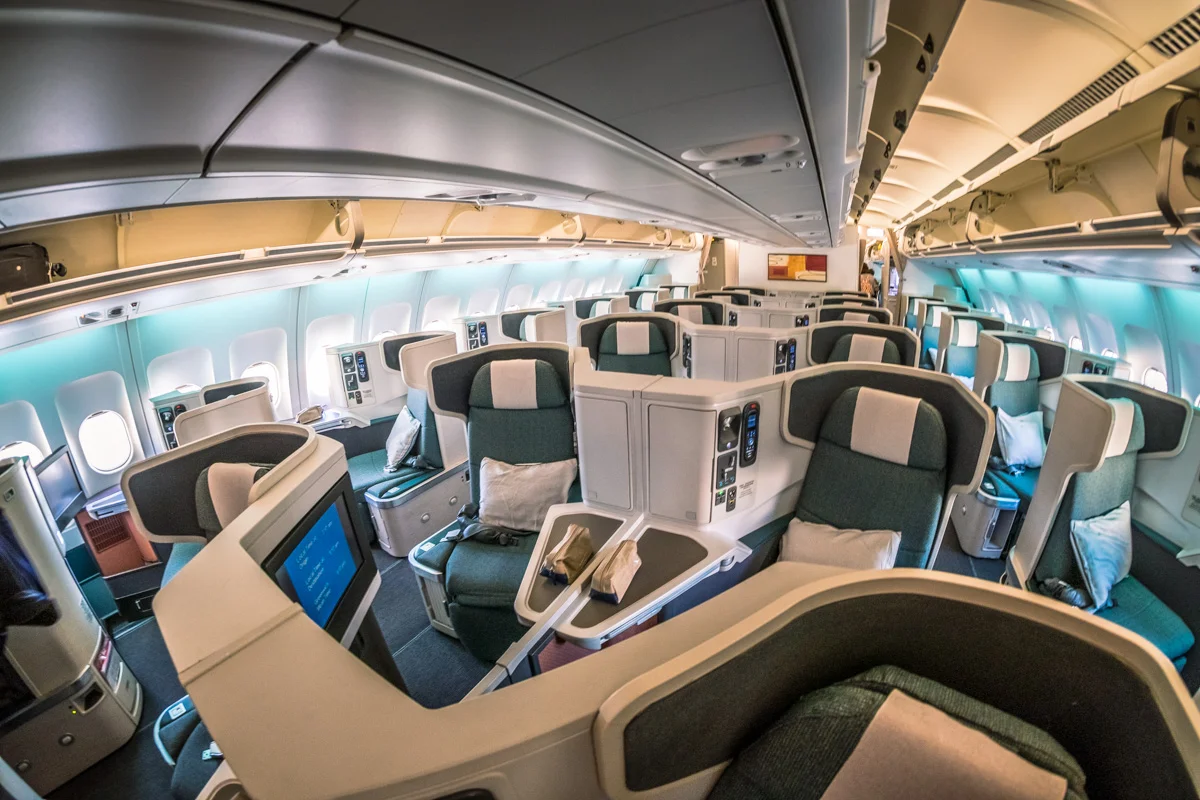
Cathay Pacific currently flies an older generation of Airbus A330-300 aircraft around Asia, mostly on regional routes to places like Tokyo, Bangkok, Delhi, and Manila. The business class on those planes is <cite index=”10-1″>a two-abreast recliner-style seat dating back to 2012</cite> — comfortable enough for a four or five-hour hop, but nowhere close to a proper flatbed.
Separately, Cathay has ordered brand-new A330-900neo aircraft (the “neo” stands for “new engine option,” Airbus’s term for its fuel-efficient re-engined jets). These are genuinely new planes, not retrofits of old ones, and they’re a different animal entirely from what’s flying today.
Here’s the part that trips people up: Cathay hasn’t finalized which seat will actually go on the A330neo. What has been confirmed is a new regional business class product called the Aria Studio, a scaled-down sibling of the long-haul Aria Suite found on refurbished 777s. The Aria Studio is <cite index=”1-1″>adorned with high-tech touches like USB-C and wireless charging, with a large 4K video screen supporting Bluetooth pairing</cite>, and it moves Cathay’s regional cabin from recliners to proper flatbeds in a 1-2-1 layout with direct aisle access. But the first jets to get it are the existing A330-300s, starting around the end of 2026 — not the neo. Cathay <cite index=”5-1″>will also install the Aria Studio on the upcoming A330-900neos, which are due as of 2028</cite>, so the two products will eventually converge, just not on the same timeline.
In plain terms: “cathay a330neo business class” is a future product on a future aircraft, expected to share design DNA with the Aria Studio seat that’s landing on older A330s first.
How It Works (Once It Arrives)
Assuming Cathay sticks with the Aria Studio direction for the neo fleet, here’s roughly how the experience should shake out, based on what’s been confirmed for the A330-300 retrofit:
- Seat layout: 1-2-1 reverse herringbone, meaning every passenger gets direct aisle access without climbing over anyone.
- Bed function: A genuine flatbed, replacing the old recliner-that-reclines-a-lot approach.
- No privacy door: Unlike the long-haul 777 Aria Suite, the regional version skips the sliding door. Cathay’s reasoning, according to General Manager of Customer Experience Design Guillaume Vivet, is that <cite index=”1-1″>a door is less crucial on relatively short regional flights compared to a 14-hour trek to London</cite>.
- Tech touches carried over: wireless charging, a curved wraparound shell with a built-in LED reading light, and noise-dampening fabric lining.
- One notable omission: the handy bathroom-availability screen from the 777 cabin <cite index=”1-1″>didn’t make the cut for the A330 refurb</cite>.
Whether the eventual A330neo seat is an identical Aria Studio unit or a further-refined version is still an open question. Airlines sometimes tweak seat specs between an initial retrofit and a factory-fresh delivery a couple of years later, so treat the final neo seat as “closely related to, but not confirmed identical to” what’s launching on the older planes.
Main Features (What to Actually Expect)
Pulling together what’s confirmed across Cathay’s regional cabin overhaul:
- Flatbed seating replacing 2-2-2 recliners
- Direct aisle access for every business class passenger
- 4K entertainment screens with Bluetooth headphone pairing
- USB-C and wireless charging built into the side console
- A completely new economy cabin arriving alongside it — Cathay’s first all-new economy seat in almost a decade
- Design language borrowed from the A321neo business class and the long-haul Aria Suite, giving the whole fleet a more unified feel
One thing worth flagging: none of this is exclusive to the A330neo. It’s part of a broader cabin strategy that touches several aircraft types at once, which is honestly a smarter way to think about Cathay’s premium product right now — as a fleet-wide direction rather than a single plane’s feature list.
Pros and Cons
Potential pros:
- A genuine upgrade from the current regional recliner, which frankly feels dated next to competitors
- Consistency with the long-haul Aria Suite means less of a “downgrade shock” when connecting between a long flight and a regional one
- Fuel-efficient engines on the neo should mean smoother, quieter cruising and possibly better range for Cathay to use these jets on slightly longer regional or secondary long-haul routes
- Modern tech (4K screens, wireless charging) that current regional flyers simply don’t have today
Potential cons:
- No privacy door on the regional cabin, which some travelers will miss, especially on longer regional sectors like Hong Kong to Delhi or Perth
- The bathroom-availability screen being dropped is a small but real convenience loss for anyone who’s used to it on the 777
- Delivery timeline stretches out to 2028–2031, so for most travelers this is not a near-term booking option
- Seat specifics for the actual neo aircraft aren’t locked in, so early adopters may find themselves flying a seat that gets tweaked or improved shortly after
Real-World Scenarios (Where This Actually Matters)
Say you’re planning a trip in 2027 from Hong Kong to somewhere in Southeast Asia and you specifically want the new flatbed experience — you’d be looking at a retrofitted A330-300, not a neo, since the neo deliveries don’t start until 2028 at the earliest. If your travel window is sometime around 2029 or later, there’s a realistic chance you could be booked onto an actual A330neo, though Cathay hasn’t published route assignments that far out.
A more common real-world scenario: someone books a regional Cathay business class ticket today, sees “A330″ in the aircraft type, and assumes they’re getting the shiny new seat. They’re not — not yet. The safest way to check what you’re actually flying is to look at the seat map during booking, the way experienced points-and-miles travelers already do for Cathay’s 777 Aria Suite rollout, where the trick is <cite index=”8-1”>looking for the “77J” seat map to confirm the newer configuration</cite> rather than trusting the aircraft type alone. A similar check-the-seat-map habit will likely apply once A330 retrofits start rolling out.
Safety, Legitimacy, and Whether the Claims Are Real
There’s no scam angle here, no legitimacy question in the fraud sense — this is a real, publicly announced Airbus order from a major, well-established airline. But there is a “temporal legitimacy” issue worth calling out plainly: a lot of travel content online blurs the line between what’s confirmed, what’s a seat-supplier rumor, and what’s marketing speculation. A little healthy skepticism is warranted, especially around exact seat manufacturer details, since <cite index=”5-1″>even aviation forums have gone back and forth on whether the design comes from JPA’s Airtek platform or the Stelia Opera platform</cite> before settling on Stelia as the actual source.
From a safety standpoint, there’s nothing unusual to flag. The A330neo is a well-proven Airbus widebody family flying with numerous carriers worldwide, and Cathay has decades of experience operating A330 aircraft safely across its network.
Common Problems and Limitations
- Availability confusion: Because “A330” covers both the old recliner cabin and the eventual new flatbed cabin, booking sites and even some travel agents may not clearly distinguish between them for years.
- Slow rollout pacing: Airlines routinely stretch retrofit programs, and Cathay’s own 777 Aria Suite rollout has moved gradually rather than all at once — at one point <cite index=”6-1″>just 11 aircraft had been reconfigured out of a fleet of more than 50 Boeing 777s</cite>. Expect the A330 program to follow a similarly staged path.
- Partner award space: Even once the seat is flying, redeeming partner airline miles for it may prove difficult, mirroring the tight partner award availability Cathay has shown on its 777 Aria Suite product.
How It Compares to Alternatives
If you want a modern flatbed on a Cathay regional route right now, your realistic options are the long-haul Aria Suite (found on select Boeing 777s connecting Hong Kong with cities like Frankfurt, Sydney, and London) or, in some cases, Cathay’s A350 aircraft, which already carry proper business class flatbeds and occasionally cover shorter regional-adjacent routes.
Compared to regional business class from competitors like Singapore Airlines or Japan Airlines, Cathay’s current A330 recliner cabin has genuinely fallen behind — which is exactly why this overhaul exists. Once the Aria Studio (and eventually the true neo version) is flying at scale, Cathay should be much closer to parity with, or ahead of, regional rivals in Asia.
An Honest, Practical Take
Having followed a fair number of airline cabin rollouts over the years, my genuine read is that this is a smart, overdue move by Cathay rather than a flashy gimmick. Their existing regional recliner cabin has needed replacing for a while, and tying the new regional seat’s design language to the long-haul Aria Suite is a sensible way to build a more coherent brand experience across the whole fleet.
That said, I’d gently push back on any headline promising you can fly Cathay’s A330neo business class soon. The honest picture is that the aircraft itself is still years from entering service, and the seat that will eventually go on it is, at best, a close cousin of a product that hasn’t even finished its initial rollout on older jets. If you’re booking travel in the next year or two, plan around what’s actually flying today rather than what’s coming down the pipeline.
Final Verdict
Cathay’s A330neo business class is a genuinely promising future product built around the Aria Studio flatbed concept, but it isn’t bookable yet in any meaningful sense, and won’t be for a few more years. If your goal is simply “get a great Cathay business class experience soon,” look at the 777 Aria Suite or the A350 instead. If your goal is tracking the airline’s long-term direction, this is worth watching — Cathay is clearly investing seriously in closing the gap between its long-haul and regional premium cabins, and that’s good news for anyone flying Asia routes down the line.
Explore More Insights: Sharemyideaz
FAQs
Q: Is Cathay Pacific’s A330neo business class available to book now?
A: No. The A330neo aircraft haven’t been delivered to Cathay yet; deliveries are expected to run from 2028 through 2031. What’s currently flying on regional A330s is an older recliner-style business class from 2012.
Q: What seat will be on the Cathay A330neo?
A: It hasn’t been fully confirmed. Cathay is expected to use a version of the new Aria Studio flatbed, the same regional product debuting on retrofitted A330-300s starting around late 2026, but the final neo-specific configuration isn’t locked in.
Q: Does the Cathay A330 business class have a privacy door?
A: The new Aria Studio regional seat does not include a sliding privacy door, unlike the long-haul Aria Suite on the Boeing 777. Cathay has said this is a deliberate choice given the shorter duration of regional flights.
Q: What’s the difference between Aria Suite and Aria Studio?
A: Aria Suite is Cathay’s long-haul business class seat found on refurbished Boeing 777s, complete with a closing privacy door. Aria Studio is the regional counterpart being installed on A330 aircraft, sharing design cues but without the door and in a slightly tighter footprint.
Q: How can I tell if my Cathay flight has the new business class seat?
A: Check the seat map during booking rather than relying on the general aircraft type. For the 777 Aria Suite, travelers look for the “77J” seat configuration code; a similar identifier will likely apply once A330 retrofits begin rolling out more broadly.
Q: Is Cathay Pacific business class worth it in general?
A: Based on current reviews of the airline’s long-haul Aria Suite, most reviewers rate the experience highly, citing quality bedding, thoughtful cabin design, and strong in-flight dining. Whether it’s “worth it” for you depends on price, route, and how much you value flatbed comfort versus cost.
