

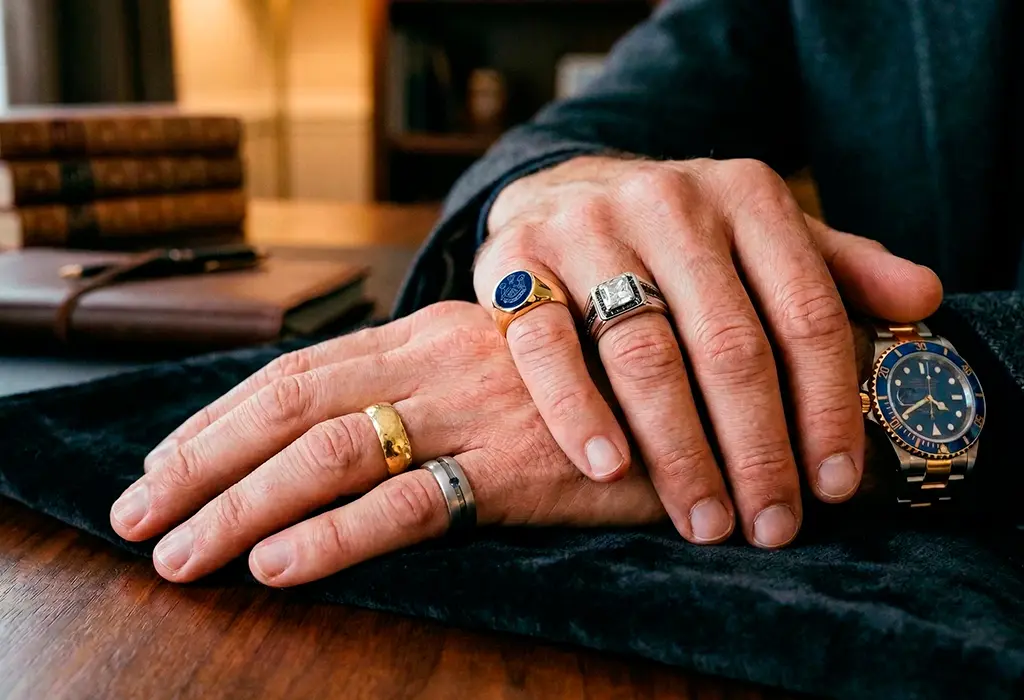
There’s a moment a lot of guys describe — standing in a jewelry store, or scrolling through Instagram at 1 a.m., thinking: could I actually wear that? A wide gold band. A chunky signet ring. Something with a black stone that looks like it belongs on a Viking or a fashion week attendee. And then they put their phone down and talk themselves out of it.
That hesitation is understandable. For most men, rings weren’t a topic that anyone ever really covered. You wore one if you got married. That was basically the rule.
But the landscape has genuinely shifted. Men’s jewelry — rings especially — has moved from niche subculture to mainstream wardrobe consideration. And if you’re curious about where to start, what actually looks good, and how to avoid looking like you raided a costume trunk, this guide is for you.
Quick Answer (For the Featured Snippet Crowd)
What is men’s rings fashion? It’s the practice of incorporating rings into men’s everyday style — beyond wedding bands — as intentional accessories that complement outfits and express personality. This includes signet rings, stackable bands, statement rings, and minimalist designs in metals like gold, silver, titanium, and oxidized brass. It works best when ring choices match a man’s overall aesthetic, fit properly, and are worn with some intentionality rather than randomly thrown on.
What Men’s Ring Culture Actually Is (And Isn’t)
Let’s get one thing out of the way: wearing rings as a man is not new. It’s actually old. Ancient Egyptian pharaohs wore elaborate gold rings as symbols of power. Medieval knights wore signet rings to seal documents. In many cultures across history, rings were standard male adornment — symbols of status, family, faith, or allegiance.
What’s new is how accessible the conversation has become. Social media, menswear blogs, and a broader cultural shift toward men expressing personal style more openly have made it normal — in many circles, even expected — to think about ring-wearing as part of a complete look.
Mens rings fashion, at its core, is about treating rings as what they’ve always been: a meaningful accessory that says something about who you are.
What it isn’t: a trend you adopt wholesale, buying ten rings at once and wearing them all on a Tuesday. That’s how you end up looking confused rather than intentional.
How It Works: Building a Ring Wardrobe
The mechanics here aren’t complicated, but they do reward some thought.
Start with one ring. Most men who wear rings well started with a single piece — often something with personal meaning. A signet ring passed down. A band bought to mark a trip. Something that felt genuinely theirs before it felt “fashionable.”
Choose a metal that works with your skin tone. This isn’t a rigid rule, but it’s a useful starting point. Yellow gold tends to complement warmer skin tones; silver and white gold can work beautifully with cooler complexions. Oxidized metals and dark finishes are fairly versatile. If you’re unsure, bring clothing you actually wear when you shop — seeing the metal against your real-world context helps.
Think about finger placement. Each finger carries slightly different visual weight and cultural connotation:
- Index finger — a classic placement for statement or signet rings; historically associated with authority
- Middle finger — visually central and balanced, works well for bolder pieces
- Ring finger — traditionally reserved for marriage, though plenty of unmarried men wear rings here
- Pinky — elegant for signet rings; has an old-world, almost literary quality
- Thumb — looks great for wide bands; has a slightly bold, unconventional feel
Consider proportionality. A slender band on large hands can disappear. An oversized statement ring on narrow fingers can look costume-y. Matching the visual weight of the ring to your hand size matters more than most people realize.
The Main Styles Worth Knowing
Signet Rings
The OG of men’s rings. Traditionally used to press a wax seal, the signet ring has evolved into a lifestyle piece. Flat-face, usually gold or silver, sometimes engraved with initials, a family crest, or a simple geometric design. Tom Hardy wears them. So does a lot of men who wouldn’t describe themselves as fashion-forward but have quietly excellent taste. They’re understated but carry weight.
Plain Bands
Not just for married people. A simple matte gold or brushed silver band on the middle or index finger reads as intentional without being loud. Great starting point for beginners.
Statement Rings
These are the pieces that make people ask “where did you get that?” — chunky silver with texture, rings set with stones (onyx, labradorite, turquoise), or sculptural shapes that function almost like wearable art. They require confidence to wear because they invite attention.
Stackable Rings
Thin, delicate bands worn in multiples on one or adjacent fingers. This style borrows from women’s jewelry but has been fully adopted in men’s fashion. Works particularly well with a more fashion-forward or minimalist-eclectic aesthetic.
Beaded and Cord Rings
More casual, often associated with travel or surf culture. These don’t “stack” the same way metal rings do in terms of formality, but for casual daily wear, they’re effortless.
Who Wears Rings? (Hint: More Men Than You’d Think)
The honest answer is: men across every demographic, age group, and style aesthetic. The idea that rings are exclusively for rock musicians or men in fashion capitals is genuinely outdated.
- A 34-year-old software engineer who pairs a thin gold band with his everyday minimalist wardrobe
- A retired tradesman who wears his grandfather’s signet ring because it feels right
- A 22-year-old who stacks three thin silver rings on his right hand because he saw it on someone he admired and made it his own
- A businessman who wears a single bold statement ring as the one piece of personality in an otherwise formal outfit
The style cuts across, and that’s actually what makes it interesting. There’s no archetype for the “ring-wearing man” anymore.
The Real Benefits (Not Just Aesthetic)
There’s something worth saying about why rings resonate beyond pure vanity. For a lot of men, accessories are one of the few socially sanctioned ways to express personality through clothing. Menswear, especially professional menswear, tends toward the conservative. A ring — particularly one with meaning — becomes a quiet way to say something about yourself without words.
Some men describe specific pieces as grounding objects. A ring worn daily becomes something you notice when it’s gone. That kind of tactile familiarity has real psychological value.
Rings also age well as objects. A quality gold or silver ring doesn’t go out of style the way a trendy jacket does. It can become part of your identity over years or decades — something you eventually pass down or simply wear until it’s inseparable from who you are.
The Drawbacks and Limitations (Being Honest About It)
Not every situation is ring-friendly, and ignoring that would be doing you a disservice.
Professional contexts can be tricky. In more conservative industries or formal settings, multiple rings might raise eyebrows. A single tasteful band is generally fine almost anywhere; three statement rings on a Tuesday morning meeting might create friction in some environments.
Physical work creates wear. Rings and manual labor don’t always coexist cleanly. Rings can scratch, bend, or in rare cases get caught on machinery — a real safety concern in certain trades. If you work with heavy equipment, removing rings is genuinely recommended.
Sizing matters more than people expect. Fingers change size with temperature, time of day, and body weight fluctuations. A ring that fit perfectly in the store might feel tight at night or loose in cold weather. This is especially relevant for fitted bands.
Not every ring ages well. Cheap plated metals wear through. Certain stones are more delicate than others. If you’re buying something you want to last, material quality is worth the investment.
Safety and Practical Concerns
This gets overlooked in style guides, but it’s worth a mention. “Ring avulsion” — where a ring catches on something and causes injury — is a real (if uncommon) risk for people doing physical work or certain sports. Medical and emergency personnel regularly recommend removing rings before activities where this risk exists.
For everyday wear in normal circumstances? Not a concern. But if you’re rock climbing, doing construction work, or operating machinery, take the rings off. Silicone rings exist specifically for active people who want to wear something but need a material that will break before your finger does — they’ve become popular among athletes and active professionals for exactly this reason.
Common Mistakes (And How to Avoid Them)
Buying too many at once. The temptation when you discover men’s rings fashion is to immediately acquire a collection. Resist it. Start with one or two pieces. Wear them. Figure out what you actually like and what feels like you before expanding.
Ignoring fit. A loose ring that spins constantly is distracting and slightly unflattering. A too-tight ring is uncomfortable and potentially problematic. Get sized properly, and remember that sizing can vary between countries (US, UK, and EU sizing systems differ).
Mismatching metals haphazardly. You can absolutely mix metals intentionally — warm gold tones with rose gold, silver with white gold — but random mixing without intention just looks unplanned. If you’re mixing, make it a deliberate choice.
Wearing rings that don’t match your aesthetic at all. A heavy industrial-style silver skull ring looks incongruent with a conservative prep wardrobe. This sounds obvious, but it happens. Your rings should feel like an extension of the rest of how you dress.
How Men’s Rings Compare to Other Jewelry
Men’s jewelry broadly includes bracelets, necklaces, earrings, and rings. Each occupies a slightly different space in terms of visibility, formality, and cultural baggage.
Rings tend to be the most accessible entry point because:
- They’re visible but not overtly “loud” the way a chunky chain necklace might be
- They have long-standing cultural precedent (wedding bands, class rings, signet rings)
- A single ring requires minimal commitment compared to coordinating a full neck stack
Bracelets are a close second — similarly low-profile but with slightly more casual associations. Necklaces and earrings can be excellent pieces but may feel like a bigger step for men newer to jewelry.
For most men starting to explore accessories, rings are the logical first move.
A Practical Opinion (Not Just Theory)
Here’s the thing about mens rings fashion that doesn’t always make it into buying guides: the best ring you can wear is one you forget you’re wearing because it feels like part of you. That’s not something you can manufacture by buying the “right” ring — it develops over time through actual wear.
The men who wear rings best usually aren’t the ones who thought most carefully about it. They’re the ones who picked up something they liked, wore it consistently, and stopped second-guessing it. Confidence in wearing jewelry comes from familiarity, not from having cracked some secret code.
Start simple. Wear something. See how it feels.
Final Verdict
Rings are one of the most versatile, durable, and genuinely meaningful accessories available in men’s fashion — and they’ve never been more socially acceptable to wear. Whether you’re drawn to a minimalist gold band or an elaborate engraved signet, the barrier to entry is lower than most men assume.
The key is intentionality. Pick pieces that feel like you — not like a character you’re auditioning for. Wear them consistently enough that they stop feeling like costumes and start feeling like extensions of your actual self.
That’s when ring-wearing works.
Learn More About Blogs On Sharemyideaz
FAQs: What Real People Are Searching
Q: Is it okay for men to wear rings on any finger?
A: Yes. There’s no universal rule that restricts men to specific fingers. Cultural conventions exist (ring finger for marriage, pinky for signet rings) but none are binding. Wear what feels right to you.
Q: How many rings is too many?
A: Context-dependent. In casual or creative settings, four or five rings can look intentional and well-curated. In formal or professional environments, one or two is often the practical limit. The real question is whether the rings look chosen or accumulated — intention matters more than number.
Q: What metal is best for men’s rings?
A: Sterling silver and solid gold are the most durable and versatile options. Titanium and tungsten are harder, scratch-resistant, and more affordable. Avoid gold-plated metals for daily wear pieces — the plating wears through. For active or outdoor use, silicone rings are a practical alternative.
Q: Do rings go on the left or right hand?
A: No universal rule. In many Western cultures, wedding bands go on the left ring finger; in parts of Europe and South America, the right hand is traditional. For non-wedding rings, wear them wherever they look and feel best.
Q: Can men wear rings in professional settings?
A: Generally yes, with some judgment. A single tasteful band or signet ring is appropriate in almost any professional context. Multiple large statement rings may be better suited to casual or creative environments. Know your workplace culture.
Q: How do I know what ring size I am?
A: Visit a jeweler for the most accurate sizing. You can also use a printable ring size chart at home, though these are slightly less precise. Remember that fingers can swell in heat and shrink in cold — size when your hands are at normal temperature (not right after a workout or on a freezing morning).
Q: What’s the difference between a signet ring and a regular band?
A: A signet ring has a flat, broad face — traditionally used to stamp wax seals — often engraved or decorated. A band is continuous and generally uniform in width all the way around. Signet rings tend to read as more heritage-influenced; bands are more minimal and versatile.
Q: Are men’s rings expensive?
A: The range is enormous. You can find quality sterling silver rings for $30–$80. Solid gold pieces typically start around $200–$400 and go up significantly with gemstones or custom engraving. Statement rings in alternative materials (titanium, blackened silver, brass) often fall in the $50–$150 range. Price doesn’t always correlate with how good something looks — fit and material quality matter more than brand name.
Q: Can I wear rings if I work with my hands?
A: It depends on your work. Office and light manual work — fine. Construction, heavy machinery, or jobs where rings could catch on equipment — take them off while working. Silicone rings are a good option if you want to wear something but need a safer material for active use.
Q: What’s the easiest first ring to buy as a man?
A: A simple matte or brushed band in silver or gold is the most universally flattering and easiest to wear. It goes with almost everything, doesn’t require styling decisions, and reads as intentional without being loud. Start there, wear it for a few months, and see if you want to build from it.
