

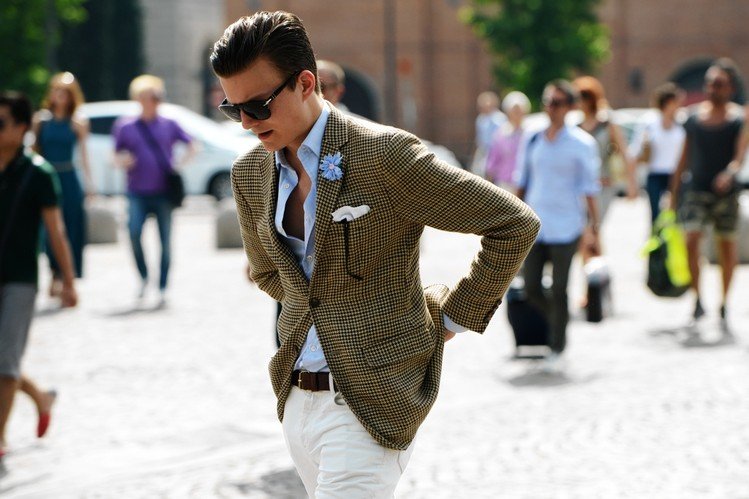
There’s a moment most people experience somewhere in Rome or Milan — you’re waiting for an espresso, and a man walks past in a perfectly fitted linen blazer, tan loafers, and trousers with just the right break at the ankle. No tie. No visible effort. Just… looks right. You instinctively glance down at your own outfit and feel vaguely underdressed, even if you thought you were doing fine that morning.
That feeling has a source. It isn’t magic, and it isn’t luck. It’s the result of a culture that has spent centuries treating clothing as craft, identity, and quiet communication all at once.
This guide breaks down what Italian male fashion actually is, how it works in practice, who it suits, and whether it’s something you can realistically adopt — or whether it stays forever on the other side of the espresso counter.
Quick Answer (For Featured Snippet Readers)
Italian male fashion is a menswear philosophy built on precise tailoring, quality fabrics, restrained color palettes, and relaxed confidence. It prioritizes fit above all else, favors natural materials like wool, linen, and leather, and tends to avoid loud branding. The look is polished but never stiff — dress shirts worn untucked, blazers thrown over a tee, loafers without socks in summer. It works for both formal and casual occasions and is widely considered one of the most imitated menswear traditions in the world.
What Is Italian Male Fashion, Really?
Ask this question to ten different people and you’ll get ten answers, but they’ll share a core thread: Italian menswear is about proportion, craft, and ease.
It emerged from centuries of artisan tradition — the tailors of Naples, the textile mills of Biella, the leather workshops of Florence. Unlike British tailoring, which leans structured and formal, or American fashion, which leans casual and logo-heavy, the Italian approach splits the difference. You get refinement without rigidity.
There are regional variations worth knowing:
- Neapolitan style (Naples): Softer construction, unlined or half-lined jackets, slightly draped fit. Considered the more relaxed, artisan-led end of the spectrum.
- Milanese style (Milan): Sharper, more structured. Milan is Italy’s fashion capital — home to Prada, Versace, Armani — and the aesthetic here leans sleeker and more contemporary.
- Roman style: Sits somewhere between the two. Less deliberate than Milan, more polished than casual Neapolitan summer dressing.
None of these are rigid categories. Most Italian men aren’t consciously dressing “Neapolitan” — they’re just wearing what they grew up seeing look good.
The Core Principles (How It Actually Works)
1. Fit Is Non-Negotiable
This is the part most guides mention and most people underestimate. Italian dressing doesn’t require expensive clothes — it requires well-fitting clothes. A €60 pair of trousers that sits perfectly on your waist and breaks cleanly at the ankle will look better than a €300 pair that bunches and sags.
The typical silhouette: slightly tapered through the leg, jackets that close at the button without pulling, shirt collars that don’t gap. Nothing overly slim, nothing boxy. The goal is that the clothes appear to be for you specifically, not something you picked off a rack.
2. Fabric Quality Over Brand Names
Italian men tend to invest in materials rather than logos. Linen in summer, flannel or wool in winter, leather that ages rather than peels. There’s a general cultural suspicion of anything that screams its own name too loudly — which is somewhat ironic given that Italy gave the world Gucci and Versace, but even those houses have periods where they dial back the logomania and the clothes simply speak.
Natural fibers breathe, drape, and age well. They’re also the foundation of most classic menswear anyway.
3. The Sprezzatura Factor
Sprezzatura is a Renaissance-era Italian concept meaning the art of making difficult things look effortless. In fashion terms, it shows up as: jacket sleeves pushed up slightly, pocket square casually placed rather than mathematically folded, shirt half-tucked. The impression of someone who got dressed without overthinking it — even if they absolutely did.
This is why copying Italian style from photographs often fails. The physical result is right but the energy is wrong. True sprezzatura can’t be forced, which is maddening but also kind of the point.
4. Color Restraint (With Purpose)
The Italian male wardrobe typically anchors around neutrals — navy, charcoal, camel, white, cream, olive. Color appears, but usually as an accent: a rust-colored pocket square, a pair of burgundy loafers, a soft sage knit worn under a grey coat.
This isn’t timidity. It’s a deliberate system that makes everything mix easily and never goes out of style.
Key Wardrobe Pieces
Here’s what actually appears in a well-curated Italian man’s closet:
The unstructured blazer — probably the single most important piece. Worn over a t-shirt for dinner, over a shirt for work, thrown on for a weekend walk. Usually in navy, camel, or mid-grey.
Slim-cut chinos or tailored trousers — not skinny, not wide-leg (unless you’re dressing very contemporarily). Classic proportions, clean lines.
Loafers — horsebit loafers, penny loafers, driving loafers. Italian men wear these more than any other shoe category. Often worn without socks in warmer months.
Quality leather belt — same tone as the shoes, always. This is one of those rules that gets followed very consistently.
A well-made white or pale blue dress shirt — collar structure matters. Worn open at the collar more often than not.
Knitwear — lightweight merino crewnecks, fine-gauge turtlenecks in winter. These do a lot of work as the middle layer between a t-shirt and a jacket.
Linen pieces for summer — linen shirts, linen trousers, sometimes full linen suits. Wrinkles are accepted, even expected.
Who Is This Style For?
The honest answer: anyone willing to pay attention to fit and invest in a few quality basics. But it suits certain people more readily.
It works especially well if you:
- Prefer classic over trendy — these looks don’t date badly
- Are comfortable in relaxed-formal situations (business dinners, weekend travel, city walking)
- Have access to a decent tailor or are willing to learn your own measurements
- Don’t need to project status through visible branding
It’s harder to pull off if:
- Your daily life requires strictly casual or strictly utilitarian clothing
- You have a body type that most off-the-rack European cuts don’t flatter (many Italian brands cut slim and for a specific build)
- You’re on a very tight budget — quality basics aren’t cheap, though they don’t have to be astronomical
The Pros
Timeless appeal. A well-fitted navy blazer and grey trousers from 2005 looks as relevant today as anything current. The return on investment for these pieces is genuinely high.
Confidence through simplicity. Once you have the foundation right, getting dressed becomes easier, not harder. There’s less decision fatigue when your wardrobe is cohesive.
Adaptability. Italian dressing bridges the gap between formal and casual in a way that few other traditions manage. The same blazer goes from a morning meeting to a casual dinner without anything feeling forced.
Genuine craft tradition. If you go the route of Italian-made products — suits from Neapolitan tailors, shoes from Carmina or Santoni, knitwear from the Marche region — you’re supporting something with real heritage.
The Cons and Limitations
The fit problem is real. If you can’t find off-the-rack clothing that fits you well, and you don’t have access to a tailor, this style is genuinely harder to execute. Poorly fitted “Italian-style” clothing looks worse than well-fitted casual clothing.
It can read as trying too hard. In certain cultural contexts — very casual cities, certain workplaces, youth-oriented social circles — a man in a blazer and loafers can look overdressed or like he’s performing something. Context matters.
Sizing is not universal. European sizing, and particularly Italian sizing, often runs slim and short through the torso compared to North American or Australian cuts. Off-the-rack Italian brand clothing may not suit every body type without significant alteration.
The full picture is expensive to replicate authentically. Entry-level versions of this look are absolutely possible, but the genuine Italian-made items — Lardini jackets, Slowear trousers, proper Neapolitan shoes — are serious investments. You can get close on a budget, but not all the way there.
Is It Legitimate? Authenticity vs. Aesthetic
This is worth addressing directly because “Italian style” gets appropriated and marketed heavily. Not everything labeled “Italian-inspired” or sold with Italian branding is actually connected to Italian craft tradition.
Some things to look for if you want the real thing:
- “Made in Italy” on the label (with the understanding that this doesn’t guarantee quality on its own, but is a starting signal)
- Brand histories that predate the marketing-first era
- Construction details: pick stitching, unlined lapels, hand-finishing on buttonholes
For most people, you don’t need to go fully authentic to capture the aesthetic. Understanding the principles — fit, fabric, restraint, ease — is enough to dress significantly better regardless of where your clothes were made.
Comparison With Other Menswear Traditions
| Style | Key Traits | Versus Italian |
| British | Structured, formal, heritage fabrics (tweed, checks) | More rigid, less emphasis on ease |
| French | Minimalist, relaxed, less tailoring focus | Overlaps somewhat; French leans more nonchalant |
| American | Casual, logo-forward, workwear influence | Much more relaxed; less tailoring emphasis |
| Scandinavian | Clean lines, neutral palette, functional | Similar restraint but less warmth and layering complexity |
Italian style occupies a particular sweet spot: more dressed than American casual, more relaxed than British formal, warmer in palette and personality than Scandinavian minimalism.
Real-World Scenarios Where This Actually Works
Business travel in a European city. A blazer over a fine-knit turtleneck, slim dark trousers, and leather Chelsea boots. Works for client meetings, works for dinner, doesn’t feel overdressed on the flight.
A summer wedding as a guest. A linen suit in stone or cream, with a white shirt open at the collar and tan loafers. Formal enough to respect the occasion, relaxed enough not to sweat through June.
A first date somewhere mid-range. Dark chinos, a well-fitted white shirt tucked loosely, unstructured navy blazer, white leather sneakers or loafers. Looks considered without suggesting you tried too hard.
Weekend city walking. A lightweight merino crewneck, slim-cut jeans in a clean wash, leather sneakers. Low effort, consistently looks good in photos.
A Practical Opinion
Italian male fashion isn’t a product you buy — it’s a set of principles you apply. The core insight is that how clothing fits and moves matters more than what it costs or which name is on the label.
The men who genuinely embody this aesthetic aren’t necessarily wearing head-to-toe Prada. A lot of them are wearing well-fitted basics from mid-range brands, one or two quality anchor pieces, and shoes that actually fit their feet properly. The ratio and the intention are what read as Italian.
If you approach this style as a costume, it’ll look like one. If you treat it as a slow build — buy one good blazer, get it tailored if needed, add a few pieces over time — it starts to feel natural and yours.
The most useful first step: get whatever you already own altered to fit properly. That single change, before any new purchases, will shift the way you look more than a shopping trip.
Final Verdict
Worth adopting? Genuinely yes — for anyone who wants to dress better without following trend cycles or accumulating a lot of disposable clothing. The foundations of Italian menswear are genuinely timeless, the principles are learnable, and even partial adoption (just: better fit, better fabrics, fewer pieces) pays real dividends.
It’s not the right fit for every lifestyle or every person’s body type or budget. But as aesthetic philosophies go, it’s one of the most coherent, well-developed, and widely applicable in modern menswear. There’s a reason fashion schools and menswear writers keep returning to it.
Learn More About Blogs On Sharemyideaz
Frequently Asked Questions
Q: What is Italian male fashion known for?
A: Italian menswear is known for precise tailoring, quality natural fabrics, restrained color palettes, and an effortless, polished aesthetic. It balances formality and ease better than almost any other dressing tradition.
Q: Do I have to spend a lot of money to dress in an Italian style?
A: No — the most important element is fit, which is primarily a matter of tailoring rather than price. A few well-chosen, properly fitted pieces will carry you further than a wardrobe of expensive but poorly fitted clothes.
Q: What shoes do Italian men typically wear?
A: Loafers are the most iconic choice — horsebit loafers, penny loafers, and driving loafers. Leather oxfords for formal occasions, clean leather sneakers or suede derby shoes for casual wear.
Q: What is “sprezzatura” in Italian fashion?
A: Sprezzatura is the studied appearance of effortlessness — making a polished look seem uncontrived. In practice: slightly pushed-up sleeves, casually placed pocket squares, shirts worn partially untucked.
Q: Is Italian fashion only for slim body types?
A: In terms of off-the-rack Italian brands, yes — many cut slim and may not suit every body type without alteration. But the principles of Italian style (fit, quality fabric, restraint) work for any build. A tailor makes this style accessible to far more people.
Q: What’s the difference between Milanese and Neapolitan style?
A: Milanese style tends to be sharper and more structured, reflecting Milan’s contemporary fashion industry. Neapolitan style is softer, more artisan-led, with lighter jacket construction and a more relaxed drape.
Q: Can I mix Italian style with streetwear or casual pieces?
A: Yes, and many younger Italian men do exactly this. A tailored blazer over a graphic tee, or quality loafers with slim jeans, merges the traditions naturally. The key is that the fitted, quality-forward pieces anchor the look.
Q: What fabrics should I look for?
A: Wool, linen, cotton, and leather for the most part. Avoid synthetic-heavy blends where possible — they tend to look cheaper and don’t breathe as well, which matters if you’re layering the way Italian style often demands.
Q: Is Italian male fashion appropriate for all climates?
A: The principles adapt well. In hot climates, lean into linen and open-collar shirts. In cold climates, layer with fine-knit wool, overcoats, and scarves. The proportions and fit principles remain the same regardless of temperature.
Q: Where’s a good starting point for building this wardrobe?
A: One unstructured blazer in navy or camel, one pair of well-fitted chinos or slim trousers, one quality leather loafer, and one or two good shirts. Start there, get them fitting well, and build outward from that foundation.
